

2 min read
The Power of Change
At this year's Life Recovery Commencement, the UGM community had the joy of celebrating men and women who completed their recovery journey. The...
4 min read
Written by UGM Men's Chaplain, Daniel Perry:
While delivering a Bible message recently, I heard a loud voice from the back of the room say, “I don’t believe in God!” His is not a lone voice. If the data is correct, 5% of Americans are atheists, 6% are agnostic, and 19% claim no religious preference. Among this 30% of our population, you will find skeptics, scoffers, and even scorners. This group can be described as non-believers or naysayers—a term for individuals who regularly oppose, doubt, or deny, often taking on the role of critic, skeptic, or pessimist.
Naysayers and skeptics are not difficult to find. They tend to announce themselves by speaking loudly from the back of the room, especially when confronted with the Word of God and Biblical truth. We live in a society that has long abandoned truth. Pilate’s voice from John 18:38 continues to echo in the public square, “What is truth?” The great skeptic, Fredrick Nietzsche (1844-1900), was famous for saying, “God is dead. God remains dead. And we have killed him.” He was referring to the loss of faith in an all-powerful deity that provides mankind with objective meaning and existence. Nietzsche rejected the belief in life after death as escapism from reality. Another well-known naysayer is Richard Dawkins. Dawkins considers faith that is not based on evidence to be "one of the world's great evils". When asked about the resurrection of Jesus Christ, Dawkins retorted, “Presumably, what happened to Jesus was what happens to all of us when we die. We decompose. Accounts of Jesus’ resurrection and ascension are about as well-documented as Jack and the Beanstalk.” Obviously, Dawkins is not a student of the Bible. Were he, he would discover that God’s word is truth. (John 17:17)
There was a group of skeptics who lived long before Nietzsche and Dawkins. They were the disciples of Jesus Christ! One might understand their skepticism in Matthew chapter fourteen of how five loaves and two fish would feed a large crowd of over 5,000 people, until they witnessed the miracle performed by Jesus in feeding the multitude. Remarkably, in the following chapter, when confronted with a hungry multitude of over four thousand, the disciples ask, “Where should we get so many loaves in this desolate place to satisfy such a large crowd?” (Matthew 15:33) Had any of them been paying attention? Even after witnessing the feeding of the 5,000, they remained skeptical.
Scripture is replete with naysaying skeptics who refused to believe God or required a sign as proof of what was being told them. Case in point: Sarah, who scoffed and laughed within herself from her tent upon hearing she would conceive and bear a son in her old age. (Genesis 18:12) God’s word was not enough for Gideon, so he put out a fleece…not once, but twice. (Judges 6:36-39) Philip finds Nathaniel to tell him he had found the One spoken of by Moses and the Prophets…Jesus of Nazareth! Nathaniel’s response, “Can any good thing come out of Nazareth?” (John 1:45,46) And let us not overlook Thomas the Apostle, the poster boy of New Testament skepticism, who refused to believe in the resurrection of Jesus Christ without physically touching Jesus’ wounds. (John 20:24-25) He may have accepted Sadducean beliefs, which denied resurrection. Through the centuries, Thomas is better known as the “doubter” rather than an apostle.
Let us not be too hard on Thomas. Obeying the command of the angel to “go and tell” (Mark 16:7), the women came and told the Apostles that they had found Jesus’ tomb empty. Scripture records that “their words seemed to them like nonsense, and they (the Apostles) did not believe them.” (Luke 24:11) Truth be told, the disciples were not rejoicing in a resurrected Savior. Instead, they locked themselves behind a closed door for fear of the Jews! (John 20:19) However, once they were enlightened by Christ and empowered by the Holy Spirit, the Apostles went forth preaching and hazarding their lives for the gospel, but not without opposition from the naysaying skeptics.
Peter and John were arrested for “proclaiming in Jesus the resurrection from the dead.” (Acts 4:2) The Apostle Paul was making inroads in Athens until he preached the resurrection of the dead. (Acts 17:22-33) To Paul’s astonishment, there were even some within the Corinthian church who were saying there is no resurrection of the dead. (1 Corinthians 15:12)
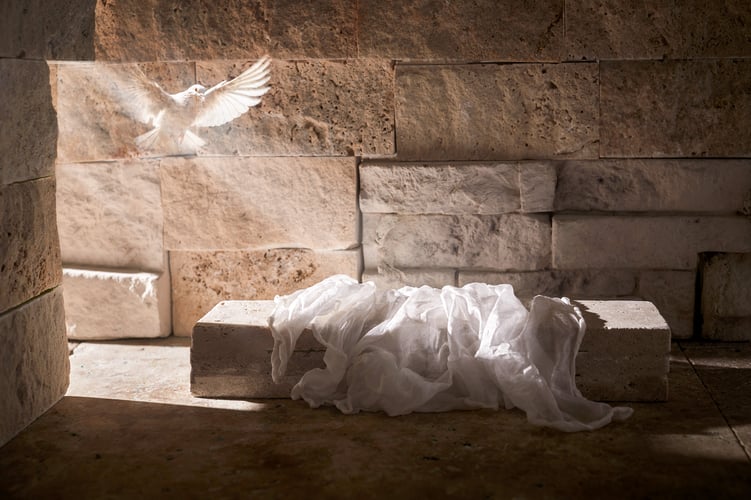
Paul reminded both the Corinthian church and modern readers that they are established in the Gospel and receive salvation through it. He makes clear that the essential elements of the Gospel are that Christ died for our sins, was buried, and was raised from the dead on the third day according to the Scriptures. (1 Corinthians 15:1-4) In The Cross-Centered Life, C.J. Mahaney writes, “If there’s anything in life we should be passionate about, it’s the gospel…I mean passionate about thinking about it, dwelling on it, rejoicing in it, allowing it to color the way we look at the world. Only one thing can be of first importance to each of us. And only the gospel ought to be.” (And the resurrection of Jesus Christ is essential to the gospel!) 1 Corinthians 15:5 begins with “and that he appeared…” There were more than five hundred witnesses to our Lord’s bodily resurrection. In verses 13-18, Paul contends that if Christ has not been raised from the dead, our faith is meaningless and we remain in our sins. Apart from the resurrection of Jesus Christ, there is no Gospel. A dead Savior can save no one! Thankfully, and all glory to God, we read in 1 Corinthians 15:20, “but in fact Christ has been raised from the dead!”
In his book, The Reason for God: Belief in the Age of Skepticism, Timothy Keller wrote, “If Jesus rose from the dead, then you have to accept all that he said; if he didn't rise from the dead, then why worry about any of what he said? The issue on which everything hangs is not whether or not you like his teaching but whether or not he rose from the dead.”
Though the number of naysayers, skeptics, scoffers, and scorners has hardly diminished, and many so inclined come through our east door and raise their voice of disbelief from the back of the room, still, after 75 years, UGM is charged with the proclamation of the Gospel (which of necessity includes the resurrection of Jesus Christ from the dead). And so, we preach Christ, crucified, risen, and coming again. Why? As Pastor Robb Brunansky drives home the point…

2 min read
At this year's Life Recovery Commencement, the UGM community had the joy of celebrating men and women who completed their recovery journey. The...
6 min read
From 2001 to 2026 This year, Union Gospel Mission of the Inland Northwest celebrates 75 years of changing lives in our communities. Over the years,...

1 min read
 Phil Altmeyer, Executive Director, Leanne White, Content and Communications Specialist: June 4, 2026
In the 1980s, I was part of Campus Crusade, a ministry working with students—future leaders—on a college campus, believing they'd make an impact on...

1 min read
 Union Gospel Mission : March 15, 2022
We are all so broken.Sin breaks us, not just our relationship with God, but our relationships with each other and with ourselves. Sin even fights...

1 min read
Union Gospel Mission : February 25, 2021
Written and performed by 2016 UGM LIFE Recovery alum Amanda Taylor.
1 min read
In 2026, Union Gospel Mission Inland Northwest is approaching our 75th Anniversary! This is a milestone that invites gratitude and reflection, and...